
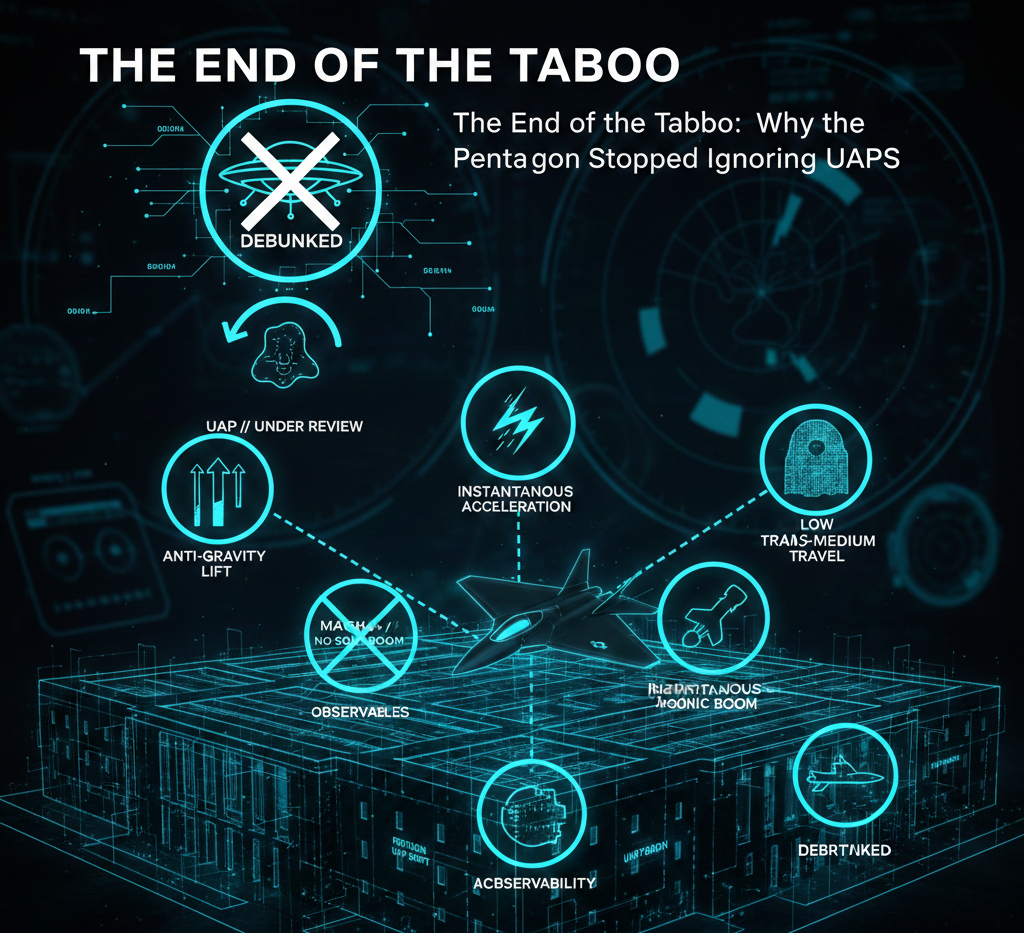
For decades, the subject was relegated to the fringes of science fiction and late-night talk shows. To speak of “UFOs” was to risk professional suicide in military or scientific circles. But between 2017 and 2026, something fundamental shifted. The stigma died, and in its place, a cold, bureaucratic reality emerged.
The Pentagon is no longer laughing. It is tracking. This is the story of how “UFOs” became UAPs (Unidentified Anomalous Phenomena) and why the global intelligence apparatus decided it was time to stop ignoring the skies.
From Science Fiction to National Security
The transition from the term “UFO” to “UAP” was not merely a linguistic tweak; it was a tactical rebranding. By shifting to Unidentified Anomalous Phenomena, authorities expanded the scope from “flying saucers” to objects that move seamlessly between space, air, and water (transmedium travel).
- The Turning Point: The leak of the “FLIR1,” “Gimbal,” and “GoFast” videos in 2017 forced the Department of Defense to acknowledge that these encounters are frequent and involve high-end military sensors.
- Legitimacy: Today, pilots are encouraged to report sightings without fear of grounding, transforming anecdotal evidence into actionable intelligence data.
The Engine of Transparency: AARO and the NDAA
The formalization of this study came with the creation of the All-domain Anomaly Resolution Office (AARO). This isn’t a secret project hidden in the desert; it is an office mandated by federal law to provide centralized reporting and analysis of anomalies across all domains.
The National Defense Authorization Act (NDAA) now includes specific requirements for annual UAP reports to Congress. This means transparency is no longer a choice—it is a legal obligation for the Pentagon.
By integrating UAP reporting into the defense budget, the U.S. government has signaled to the world that these objects represent a Flight Safety and National Security issue, regardless of their origin.
Why Now? The End of the Taboo
The primary reason for this shift isn’t just “disclosure” for the sake of the public. It is battlefield awareness. In an era of hypersonic drones and advanced electronic warfare, the military cannot afford to have “unknowns” operating with impunity near sensitive assets.
The New Standard:
- Scientific Neutrality: Moving away from “belief” and toward sensor-driven data.
- Institutional Accountability: Congressional oversight ensures that the era of hiding data in “legacy programs” is under threat.
- Global Precedent: As the U.S. declassifies, allies are following suit, creating a global network of UAP data sharing.
Conclusion
The “UFO Taboo” is dead. We have entered an age where the question is no longer if these phenomena exist, but what they are and how they operate. For the first time in history, the doors of the Pentagon are slightly ajar, and the data is beginning to flow.
Welcome to the Era of Anomalous Intelligence.
The transition from “UFO” to UAP (Unidentified Anomalous Phenomena) was a tactical rebranding that ended decades of stigma. The Pentagon is no longer ignoring the skies; it is building a formal intelligence apparatus.
Institutional Accountability
The creation of the AARO and the mandates of the NDAA have made transparency a legal obligation. This new era is currently led by Dr. Jon Kosloski, whose doctrine we analyze in the AARO 2026 Update.
As disclosure moves forward, the military is focusing on identifying objects that exhibit impossible flight characteristics, known as The Five Observables.